


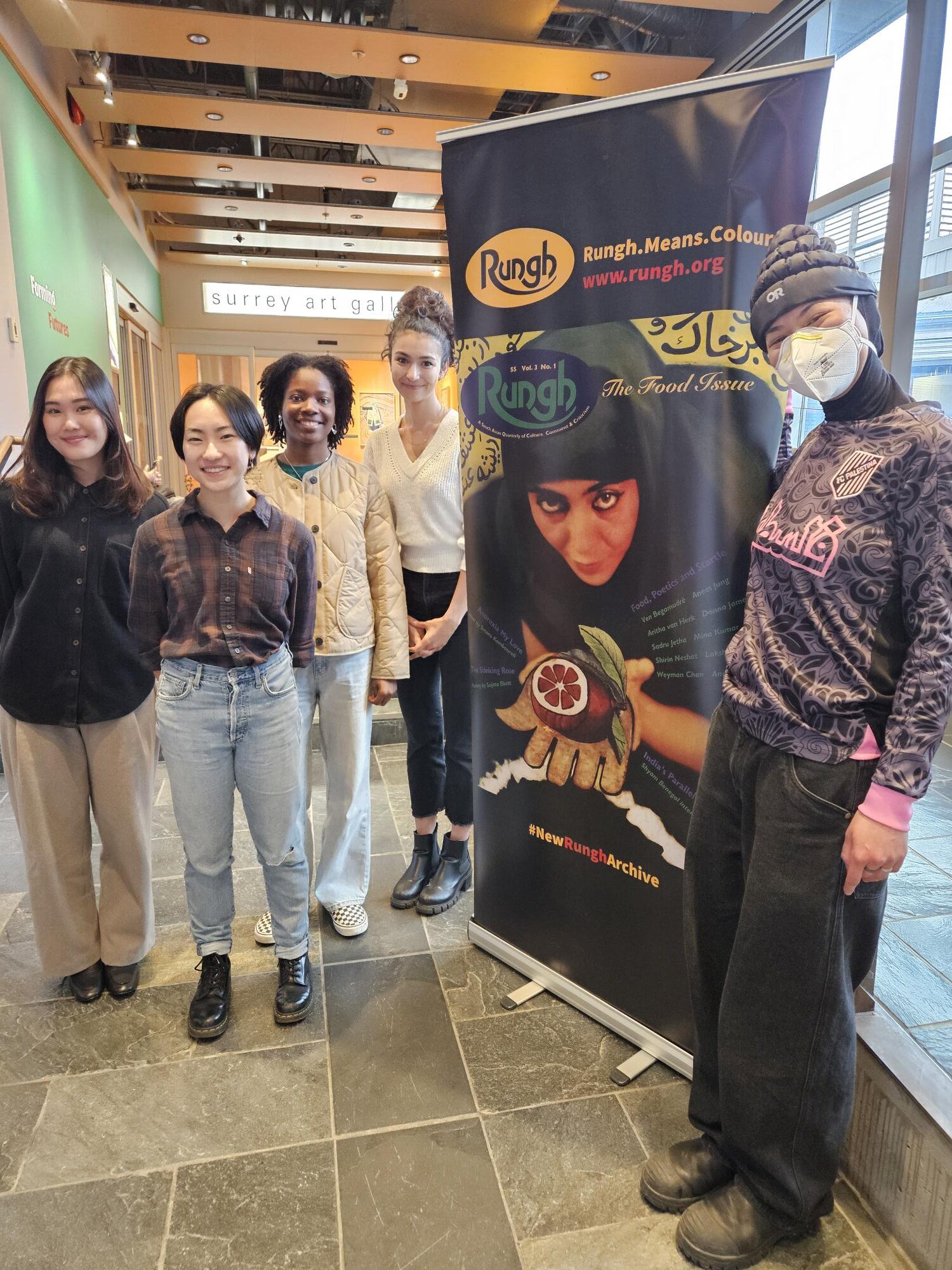
Article written by Zool Suleman from Rungh
Having died in 1999 and returned back to life in 2017, Rungh is very cognizant of the shortage of Indigenous, Black, and racialized (IBPOC) arts and cultural histories in Canada. Upon Rungh being relaunched as an IBPOC Canadian arts platform in 2017, it was somewhat dismaying to see that very little had been written about Rungh during its demise. This cultural amnesia is not unusual for racialized artists and arts projects in Canada.
Upon its relaunch, Rungh committed to record the long arc of Canadian IBPOC cultural histories with a renewed vigour. Initiatives like Recollective: Vancouver Independent Archive Week, Longing and Belonging: 1990s South Asian Film and Video, Komagata Maru: Pasts, Presents, Futures, the Archive Creation Residency, and the award winning Rungh Redux digital network are a part of the long arc approach, which views the archive as a site for creation. The Rungh Wikipedia Scholars program has become a part of Rungh’s commitment to the long arc of memory.

Rungh’s journey to the scholarship program began with the formation of an Archive Creation Group in the fall of 2017. With the support of then Executive Director, Tyler Russell at Centre A, Dana Qaddah, Rusaba Alam, Simon (Grefiel) Yu, and Y Vy Truong joined Rungh’s inaugural Research Creation cohort with the aim of conducting archival research in Rungh’s archive. In 2018, artist Zinnia Naqvi introduced Simranpreet Anand to Rungh. At the time, Simranpreet was involved with both the Surrey Art Gallery as an Engagement Facilitator and the Western Front as a Curatorial Assistant. Following a set of conversations, which involved exploring a Wikipedia page posting for Rungh, the idea of a Wikipedia edit-a-thon event was born in August 2018.
In 2019, Rungh held Wikipedia edit-a-thon events at both the Surrey Art Gallery (March 2019) and Centre A (April 2019). These edit-a-thon events have taken place since 2019 at either or both venues, except for a break in 2020 during the Covid-19 pandemic.
In 2024 Rungh initiated the Rungh Wikipedia Scholars program—Canada’s first IBPOC-focused cultural scholarship focusing on researching and creating Wikipedia entries about IBPOC-identified artists and communities. The 2024 cohort included Siimi Itabaaza, Bo Bae Lee, Eliana McFarlane, Mila Natasha Mendez, Jennifer Multani, and Aneil Sidhu. In 2025, the selected scholars were Amy Leung, Jordan Redekop-Jones, Kai Barcellos Luna, Kikachi Memeh, Lauren Han, Lauren Maharaj and Shafira Vidyamaharani.
The scholars are urged to prepare “draft” entries on their chosen subjects, and these “drafts” are then published in Rungh and on Wikipedia. While Wikipedia’s editors may choose to publish the “drafts” as public-facing entries or not, Rungh publishes the “drafts” as works in progress. In addition, Rungh encourages the scholars to reflect upon the process they have engaged in and publish reflections. You can see both types of research and writing at Rungh’s Wikipedia Scholar’s Initiatives page. A selection of the research and reflections written by the scholars is now a part of Volume 12, Number 4—a special issue focused on the Wikipedia Scholars program.
The scholars are chosen by the nominating partner institution and then enter a months-long research and creation process that includes mentoring, information talks, research, public presentations, and writing. The nominating partners now include the University of British Columbia’s Asian Canadian and Asian Migration Studies program (UBC-ACAM), Kwantlen Polytechnical University (KPU), Simon Fraser University’s Centre for Comparative Muslim Studies (SFU-CCMS), and The Black Arts Centre (BAC). Each nominating partner is represented in the program by a Project Lead including Szu Shen and Dr. Henry Yu for UBC-ACAM, Dr. Asma Syed for KPU, Hafiz Akinlusi for BAC, and Parsa Alirezaei for SFU-CCMS.
Wikimedia Canada, the official chapter of the Wikimedia Foundation in Canada, became engaged with the scholarship program in 2024 and is now a funding partner and has provided training and information sessions to the 2025 cohort of scholars. The Wikimedia Canada partnership is led by Executive Director Louis Germain, and Program Officer Chelsea Chiovelli.
In their reflection, 2025 scholar, Mila Natasha Mendez writes about how Wikipedia’s standards of notability impede the recording of IBPOC artist histories on the Wikipedia platform:
“What is notability then for people, artists or otherwise, who are required to write or speak themselves into the cultural record from which they have been ignored, neglected, or erased for reasons of racism, cissexism, ableism, or otherwise? What of people you have been enclosed by “orthography of the wake” and who seek to language themselves into presence and dignity on their own terms? The “orthography of the wake” is what Christina Sharpe has termed that which has become conventional for writing about Black bodies in the afterlife of slavery. From the Greek orthos, meaning ‘correct,’ and -graphia, ‘writing,’ it describes the conventional way of spelling that is solidifying the climate of anti-Blackness that persists in the wake of the Trans-Atlantic Slave Trade.
Within this convention, the phenomenon of white people writing about Black people that commonly in a way that serves the upholding of white dominance, what emerges is a field of art criticism that also refuses to take Black art seriously on aesthetic and theoretical terms. That results in a mainstream context in which Black artists are being mentioned, acknowledged, and sometimes interviewed, their voices included, but their work is not studied or upheld to the same rigour of perception as art and artists unmarked by race. The discursive construction occurring here is that their work is of lesser quality than non-Black art, or that the labour of its production is more so the work of a craftsperson or artisan than a serious artist. What this means then is a dearth of expectation to read and produce work on Black art that addresses histories, politics, aesthetics, techniques, and lineages.”
2025 scholar Lauren Maharaj’s entry on Nora Hendrix was published in a public-facing post by Wikipedia (at the time of the publication of this article) and summarizes their tactics to overcome Wikipedia’s barriers:
“While researching and writing my biography on Nora Hendrix, two tactics proved incredibly useful to sustaining the verifiability of my article: thoughtful source compilation and syntax selection. Each sentence I formed referenced a melange of local news coverage that, only once pieced together, painted an expansive view of Nora’s life. Having been fact-checked, properly accredited, and regularly updated, each article was verifiable in its own right; together, they supplanted unreliable biographical sources. Where these sources factually conflicted (most commonly in reference to dates, names, and places), generalizing syntax offered the most reliable means to communicate information accurately: “Hendrix… moved to Vancouver, British Columbia from the United States circa 1912.” Rather than discrediting one set of facts in selection of another, these linguistic allowances further enhanced the verifiability of my article by citing multiple sources—all while preserving the veracity of the facts presented. This is how I discovered that how you deliver a story is of equal—if not greater—importance than nailing down the details you tell.
In the case of Nora Hendrix (and other stories like hers), the challenge is not just in unearthing the facts but in presenting them in a way that is verifiable and respectful of the intricacies of community histories. Through considerate source selection and choiceful language, it is possible to ensure that marginalized stories occupy space within the internet’s collective history.”
Despite the barriers, over the last two years, the scholars have managed to research and write about a variety of subjects, including Audie Murray, Chloe Onari, Nora Hendrix, Swapnaa Tamhane, Kyo Lee, Nya Lewis, and Mandeep Wirk.
In future years, Rungh’s hope is to continue to grow the program through partnerships across Canada.
Photo credit: Zool Suleman/Rungh